Salt Air Is Eating Your Roller Door: A Perth Coast Guide
If you live within a couple of kilometres of the coast in Perth, salt is the single biggest factor in how long your garage door lasts — bigger than the brand, bigger than how often you use it, and considerably bigger than anything on the price tag. It is also the factor most people discover far too late, because salt does its worst work where you cannot see it.
We work coastal doors constantly, from Cottesloe and Mosman Park through Scarborough, North Beach and Sorrento up to Hillarys, and south to Coogee and Fremantle. The pattern is consistent enough to be predictive, which is the useful part: if you know what fails first, you know what to look at.
The mechanism, briefly
Salt does not rust steel by itself. What it does is make the water that is already in the air far more effective at doing it. Airborne salt lands on every surface and stays there. It is hygroscopic, so it pulls moisture out of humid overnight air and holds a thin damp film against the metal even on days when it has not rained. That film, with dissolved salt in it, is an electrolyte — and an electrolyte turns ordinary slow oxidation into an electrochemical process running continuously.
Two consequences follow, and both explain what we actually see. First, corrosion concentrates wherever the salt film can sit undisturbed: inside the curtain, in the folds of the slats, on spring ends, on fixings, in the guides. Second, rain helps — genuinely. A good downpour washes salt off. It is the long dry stretches between rain events, which Perth has in abundance from November to April, when salt sits on a door for weeks doing uninterrupted damage.
What fails first, in order
1. Fixings and fasteners
The screws, bolts and brackets holding the door's hardware to the structure are usually the smallest cross-section of steel in the whole assembly, which means a given depth of corrosion costs them proportionally more strength than it costs a slat. They also sit in exactly the crevices where a salt film is never washed away. A coastal door where the guides have started to move slightly under load is almost always a fixing problem rather than a guide problem.
2. The spring
This is the important one, because it is the failure that leaves you with an unusable door and a genuine hazard. A spring works by flexing millions of times through its life, and every corrosion pit on its surface is a stress riser — a tiny concentration point where a crack can start. Corrosion does not make a spring weak all over; it makes it fail at a point, suddenly, often years before its rated cycle count. A coastal door's spring life is materially shorter than the identical door's spring life in Thornlie, and that is not a sales line, it is metallurgy.
3. The bottom rail and the last slats
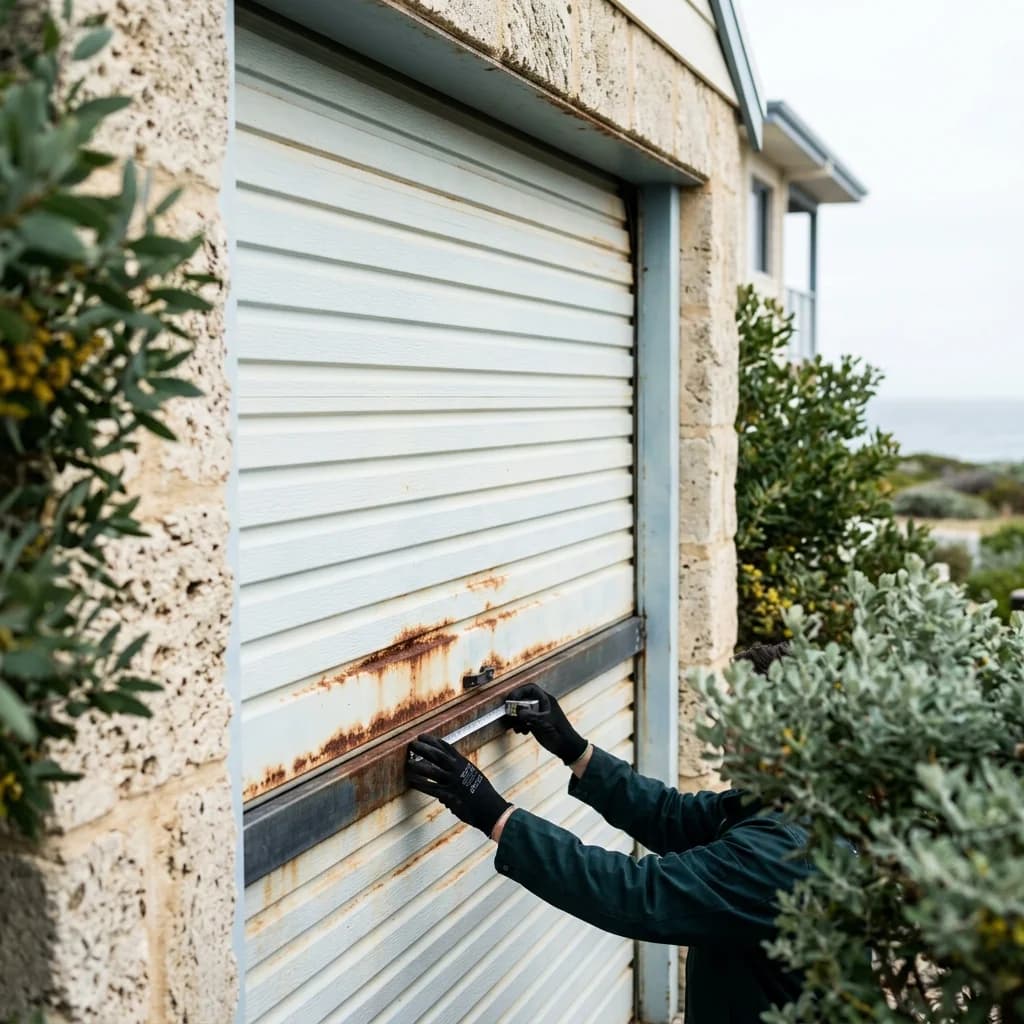
The bottom of a roller door sits against a slab that holds moisture, catches the salt spray that runs down the door's face, and never dries as fast as the rest. It corrodes from the inside out, so by the time you see it from the driveway the section is usually well gone. The good news is that a bottom rail is a separate component and replacing it is routine work rather than a new door — provided the corrosion has not travelled up into the slats themselves.
4. Barrel bearings and the curtain's inner face
The last stage is the one that ends the door. Bearings at each end of the barrel seize or become rough, and the inner face of the curtain — which nobody ever inspects, because it spends its life rolled up inside the housing — thins and pits. A door can look entirely presentable from the street with a curtain that is structurally past saving. This is why a proper inspection on a coastal door starts with the door open and the housing looked into, not with the paintwork.
How far inland does it actually reach?
Further than most people expect, and the afternoon sea breeze is the reason. Perth's summer south-westerly is strong, reliable and carries salt aerosol several kilometres inland. The effect drops off steeply with distance — a door in Cottesloe is in a completely different environment from one in Subiaco, only a few kilometres apart — but the boundary is not the beachfront street. Suburbs a few kilometres back still see a measurably shorter component life than the eastern suburbs do.
Two local factors modify it. Elevation and exposure matter: a door on an elevated frontage in Sorrento with an uninterrupted westerly aspect takes far more than one tucked behind a dune line. And a garage that stays closed traps a humid, salty atmosphere inside with the door's own hardware, which is why a holiday house that gets opened once a month often ages worse than a house lived in every day.
What actually helps
Rinsing. That is the honest headline. Fresh water removes the salt film, and removing the salt film stops the process — there is no product that beats simply washing the door down, guides included, with a hose. Monthly through summer is a reasonable rhythm on the beachfront; quarterly is fine a few kilometres back. It costs nothing and it is the single most effective thing a coastal owner can do.
- Rinse the door face, the side guides and the bottom channel with fresh water, then let them dry.
- Do it more often through the dry months, not less — that is when salt sits undisturbed.
- Keep the bottom channel clear of sand, which holds moisture against the rail.
- Look into the housing occasionally, or ask us to: the inner face of the curtain tells the truth before the outer face does.
- Do not paint over corrosion on a spring or a fixing. It hides the problem and changes nothing underneath.
- Do not oil the curtain. It attracts sand, which is abrasive. Lubrication belongs on specific moving parts, not on the door face.
The specification of the door itself is the other half. Coastal-grade coatings and appropriate fixings are a genuine engineering difference rather than an upsell, and they can add many years to a door's life in the same driveway. The corollary matters just as much: that specification is a waste of money on an inland address, and we say so. When we quote a new door or replacement we specify to the address, not to the catalogue.
When repair stops being the right answer
Our default across Perth is to repair rather than replace — barrels get re-tensioned, guides get straightened, bottom rails get swapped, and a sound door gets years more life. On the coast that default shifts, and it is more honest to say so than to keep selling components into a door that is losing the argument.
The line, roughly: if the curtain's inner face has thinned or perforated, if the spring has already failed once on a door of that age, or if you are replacing your second corroded component in eighteen months, the economics have turned over. In suburbs like Hillarys, where a large stock of doors went in during the estate build-out of the eighties and nineties, that conversation is now the common one rather than the exception. Our roller door repairs service will tell you which side of that line your door is on, and we would rather say it plainly than keep coming back.