Perth Summer and Your Garage Door: What 40 °C Actually Does
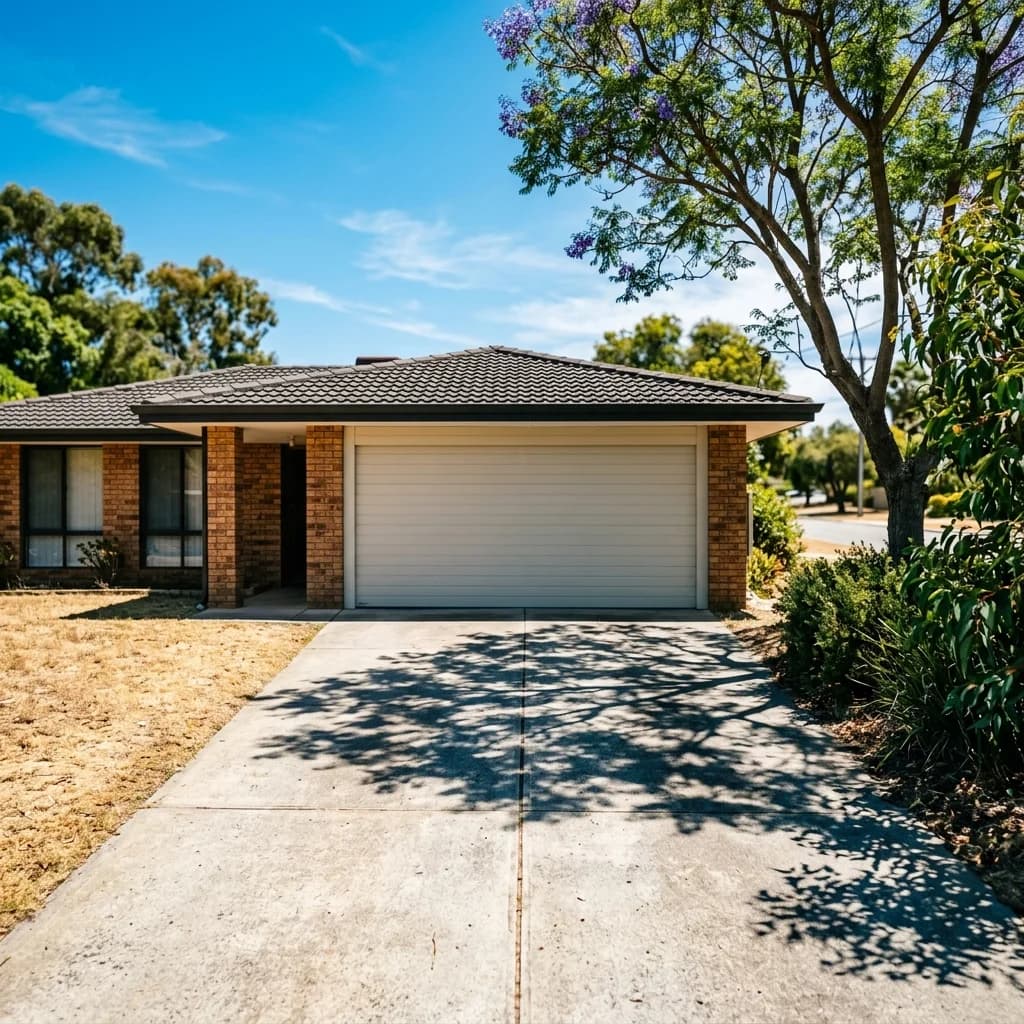
Every year, from about the second week of December, the calls change. The door that has behaved itself since winter starts stopping halfway, or refusing the remote from the end of the driveway, or making a noise on the way up that it never used to make. Nothing was touched. Nothing was hit. The only thing that changed is that Perth got hot.
A garage door is a mechanical system with fairly tight tolerances, and Perth summers push on almost every one of them at once: sustained heat well into the high thirties, harsh direct sun on a west-facing frontage, a strong sea breeze most afternoons carrying fine sand inland, and dry air that hardens rubber. None of that breaks a door on its own. Together they surface every weakness the door already had.
Why does the fault only show up in the afternoon?
This is the single most diagnostic question you can ask yourself, and the answer usually points straight at the cause. If the door works at seven in the morning and misbehaves at five in the afternoon, you are looking at something that changes with temperature or with the sun's position, not something that is broken outright.
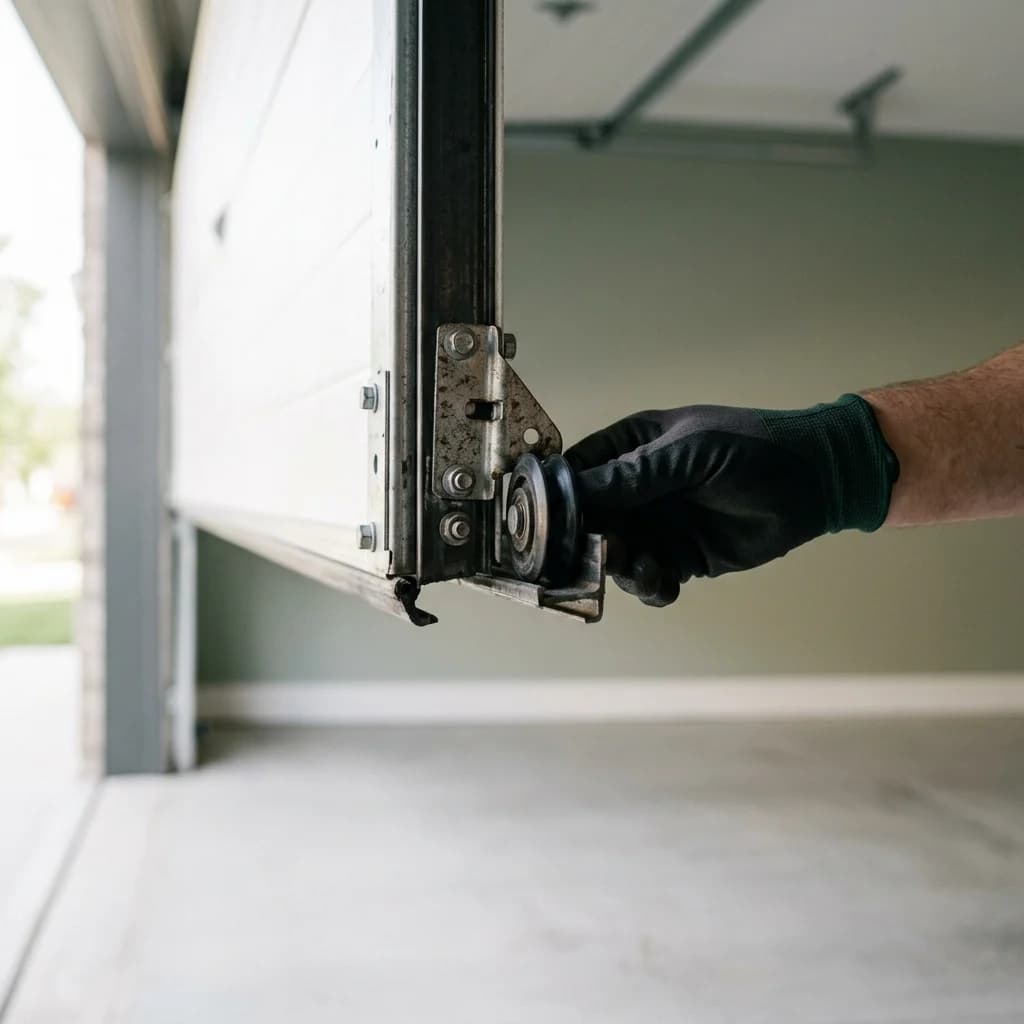
Steel expands when it gets hot. A sectional door's panels, its track and its rollers all grow slightly, and a door that was set up with barely enough clearance in July can bind in February. The same applies to a roller door curtain running in its side guides. It is rarely dramatic — a millimetre here and there — but the motor reads binding as an obstruction, and the door stops or reverses. That is the auto-reverse safety function doing precisely what it should.
Low afternoon sun does something different and equally seasonal. The safety beams either side of your opening sit at ankle height, and if the sun gets in behind the receiver at the right angle it washes the beam out entirely. The door will open perfectly and refuse to close, and it will do it between roughly four and six o'clock and at no other time. A shade hood or a small repositioning solves it permanently; replacing the sensors does not, because they were never faulty.
The bottom seal is doing more work than you think
The rubber strip along the bottom of your door is the cheapest component on it and the one that takes the most punishment. UV hardens it, heat cycles it, and a concrete slab that reaches surface temperatures well above air temperature bakes it from below every summer afternoon. Once it hardens it stops conforming to the slab, and everything that follows is a consequence: dust and fine sand blow straight in under the door, insects and reptiles find the gap, and water gets in during the first proper winter downpour.
It is also a safety component on a sectional door, because many bottom seals house the pressure edge or sit directly on the path the safety system is protecting. A perished, curled seal that fouls on a lifted edge of the slab spikes the door's resistance and produces exactly the mid-close reversal that gets blamed on the motor. Replacing a bottom seal is one of the smallest jobs we do and one of the most consistently worthwhile.
Sand is the Perth-specific one nobody mentions
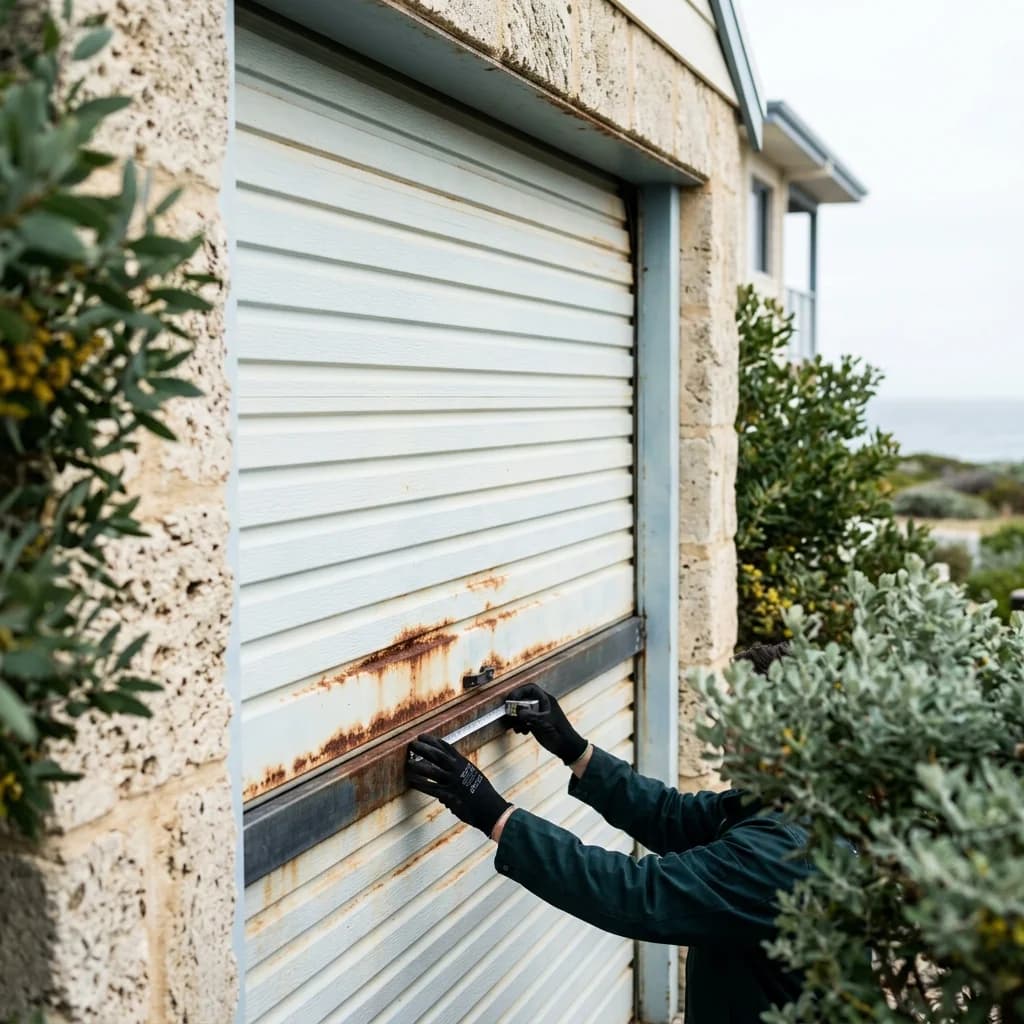
The afternoon sea breeze that most of Perth gets through summer carries fine sand a long way inland — not just in the coastal suburbs, though it is worst there. That sand settles in the side guides of a roller door and in the bottom channel where the door lands, and every single cycle drags the curtain edge across it. It is a mild abrasive working on a painted steel surface a couple of thousand times a year.
You hear it before you see it. A roller door that has developed a low grinding rumble on the way up, where it used to be a smooth whirr, is very often nothing more exotic than grit in the guides. Rinsing the guides out with a hose and letting them dry does more good here than most of the products sold for the purpose, and it is the one bit of maintenance we actively encourage owners to do themselves. If the noise persists after that, it has moved into the barrel bearings, and that is a call rather than a chore — the detail is in our guide to what a noisy garage door is telling you.
Motors cut out in summer, and it is usually not a fault
Garage door motors are rated for intermittent duty. They are designed to run for a few seconds, then rest. Most units include a thermal cut-out that shuts the motor down when its windings get too hot, and it resets itself once things cool. On a 41-degree day, in a closed garage that has been baking since noon, the ambient temperature the motor starts from is already high — so a motor that would happily do six cycles in a row in August can cut out after three in February.
If your motor stops responding after several consecutive cycles on a hot day, then works again half an hour later, that is thermal protection, not failure. What matters is why the motor is working hard enough to trip it. A well-balanced door barely loads the motor at all. If yours is tripping regularly, the door underneath it is almost certainly out of balance, and that is a spring conversation rather than a motor one. Our garage door motor and remote repairs service always starts by checking the door by hand for exactly this reason.
Heat and springs: the quiet one
Springs do not fail because of a hot day. They fail because they have run out of cycles. But summer is when a fatigued spring gets found out, because a spring that has quietly lost tension over five years leaves the motor carrying the difference, and a motor already running hot has no margin left. That is why a disproportionate number of the broken-spring calls we take land in January and February — not because the heat broke the spring, but because the heat removed the last of the slack that was hiding it.
The signs are worth knowing before you are standing in a hot garage at six in the morning: a bang from the garage with nobody near it, a visible gap in the coil of the spring above the door, a door that has suddenly become extraordinarily heavy by hand, or one side sitting higher than the other. If that is your door, stop using it. Everything about why is in why springs are the one repair you should never DIY, and the work itself is our garage door spring and cable repairs service.
Remotes get worse in summer too
Two heat-related causes, both cheap. Lithium and alkaline remote batteries lose voltage faster when they spend their life in a hot car, and a remote that works from two metres but not from the end of the driveway is almost always a battery on its way out rather than a receiver problem. The second is interference: summer is when air conditioners, pool pumps and outdoor LED lighting run hardest, and cheap switch-mode power supplies are a well-known source of radio noise in the frequencies garage remotes use.
Before assuming the worst, work through the checks in our guide to a garage door remote that has stopped working. If the wall button still operates the door, the motor is healthy and the problem is in the remote or the receiver, which is a far smaller job.
The garage as a room, not a car park
More Perth garages are workshops, gyms and home offices than ever, and that changes what a door is for. An uninsulated steel door on a west-facing frontage is effectively a solar collector: it absorbs afternoon sun and radiates it into the space for hours after the sun has gone. If you are spending time in there, insulation stops being a nice-to-have and starts being the difference between a usable room and a sauna.
The honest caveat is that insulation only works if the door seals. An insulated panel with a hardened bottom rubber and gaping side seals is doing a fraction of the job it could. When we quote an insulated door or a replacement for a garage someone actually uses, the seals are part of the specification rather than an afterthought.
The summer checklist worth ten minutes
- Rinse the side guides and the bottom channel with a hose and let them dry — this is the highest-value thing you can do yourself in Perth.
- Look along the bottom seal for hardening, cracking or a curled edge that catches on the slab.
- Wipe both safety beam lenses with a dry cloth and check whether low afternoon sun is hitting the receiver.
- Watch the door travel and listen for a new grinding or scraping note that was not there in winter.
- Change the remote battery before you conclude anything else is wrong.
- With the door CLOSED, pull the manual release and lift by hand to waist height — if it does not hold position, the springs need attention.
None of that is a repair. It is the ten minutes that tells you whether you have a maintenance item or a mechanical fault, which is the same ten minutes we would spend on arrival. If the answer is a mechanical fault, our garage door repairs service covers it, and if the door has left you locked out or exposed in the meantime, 24/7 emergency repairs is the same phone number at any hour.