Garage Doors in the Perth Hills: Gradients, Storms and Blackouts
Work on garage doors across Perth for long enough and the scarp starts to feel like a different city. A door in Kalamunda or Roleystone faces a set of conditions that a door in Cannington simply never encounters, and the faults that follow are predictable enough to plan around. Four things drive almost all of it: gradient, weight, litter and power.
Gradient: the detail that changes how a door seals
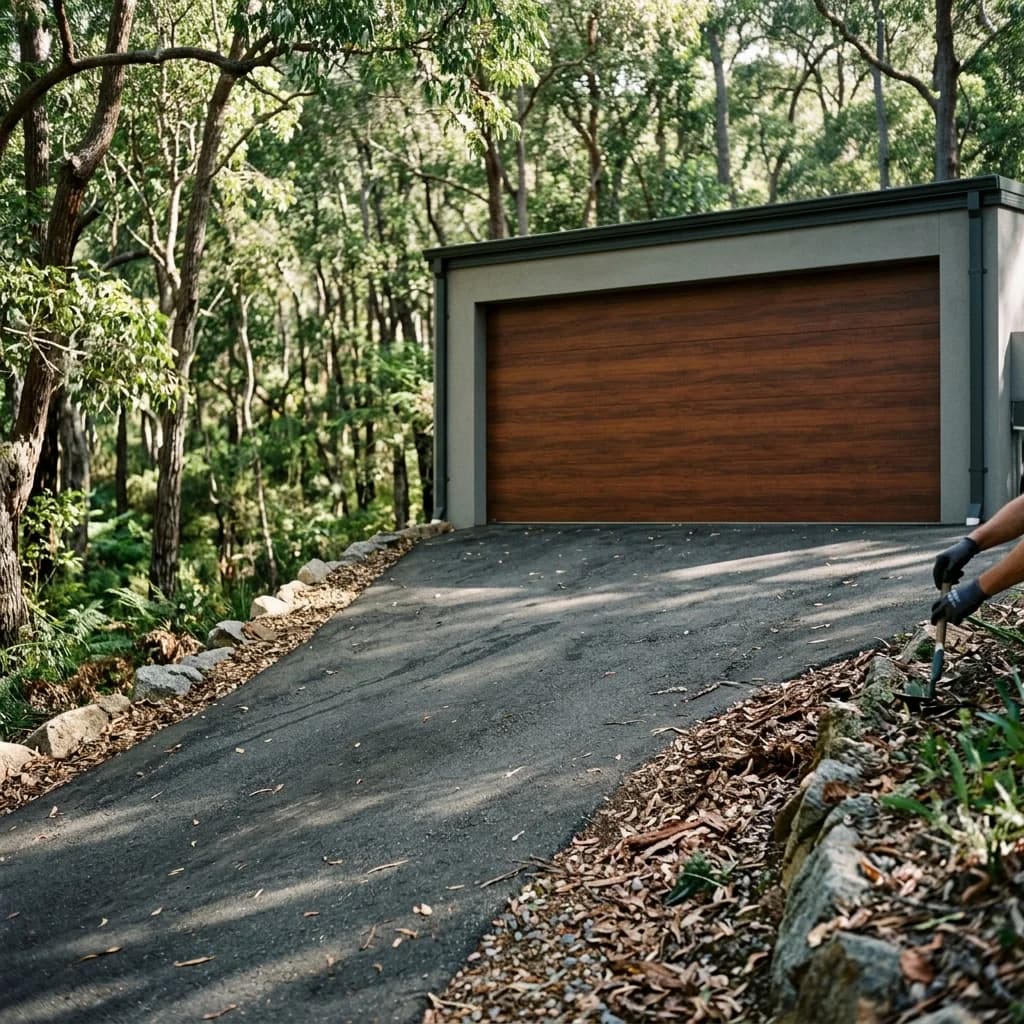
Hills driveways rise or fall steeply to the garage, and a surprising amount follows from that. The critical consequence is at the bottom of the door: when the driveway grades noticeably, the door's bottom edge and the concrete it lands on are not parallel. The seal contacts hard at one corner and barely at the other.
So the wear is uneven and one corner is always ahead of the rest. Water tracks in at the low corner during winter, sand and leaf litter collect there, and the bottom rail corrodes at that end while the rest of it still looks fine. It is entirely fixable — the right seal profile and, where the grade justifies it, a threshold treatment — but only if the person looking at the door has registered the slope rather than treating it as a flat opening.
The second gradient consequence is access, and it is ours rather than yours. Driveways in Gooseberry Hill are steep enough that a service vehicle often cannot turn once it is down, so a hills job gets loaded differently: everything likely to be needed goes down the drive on the first trip, because walking back up for a part costs twenty minutes rather than two.
Weight: timber doors and springs that must be sized, not guessed
The hills have a much higher proportion of timber and timber-clad doors than the plain, for the obvious reason that they suit the setting. They are also considerably heavier than a steel panel door of the same size, and timber's weight is not constant — it takes up moisture through a wet winter and sheds it through summer, so the same door genuinely weighs more in August than in February.
That matters because the spring system is counterbalancing that weight. A spring sized from a generic chart rather than from the door's measured weight will be wrong, and it will be wrong in a way that shows up as a motor working too hard, a door that will not hold position at mid-travel, and a spring that fails early. Weighing the door is standard practice on our spring and cable repairs, and on a hills timber door it is not optional.
Litter: the fault that gets misdiagnosed as a sensor
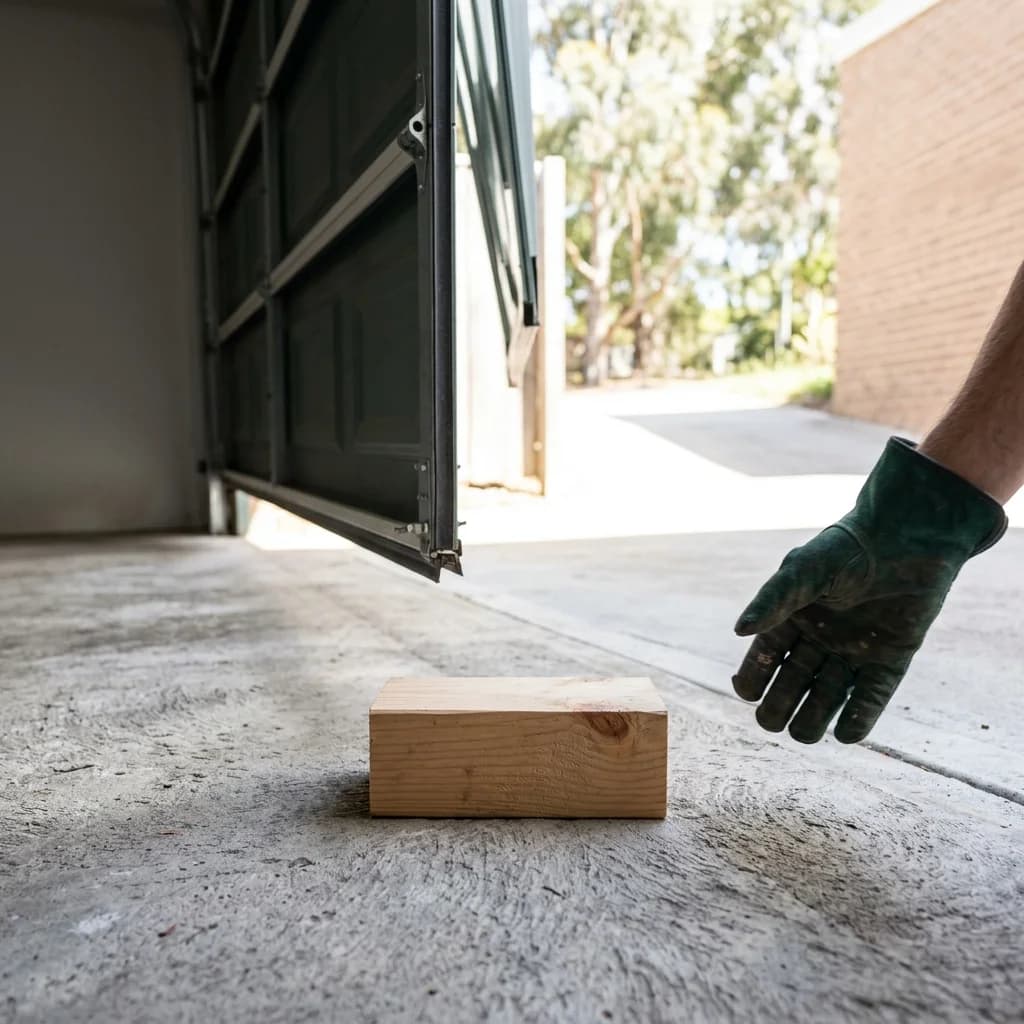
Under jarrah and marri canopy, the bottom channel of a garage door is never clear. Bark, leaves, marri nuts and seed pods collect in it continuously, and on a windy day they arrive faster than anyone sweeps. Then the door closes onto them.
What the owner experiences is a door that stops and reverses, and the near-universal assumption is a faulty safety sensor. It usually is not. The door is detecting an obstruction because there genuinely is one, and the auto-reverse is doing exactly its job. Before anyone replaces anything on a hills door that has started reversing, the channel gets cleared and the door gets cycled again — that alone resolves a meaningful share of the calls we take from Lesmurdie and the surrounding streets.
Power: why the manual release matters more up here
The hills lose power in storms more often than the coastal plain, and get it back later. That turns a piece of trivia into a genuine safety item: the manual release, the cord with a red handle hanging from the motor's trolley, is the only thing standing between you and a car locked in a garage on a morning you need it.
Two things go wrong with it, and both are quiet. The first is that nobody has tested it in ten years, and a release that has never been exercised can be seized or its linkage corroded. The second is subtler and more important: pulling the release only helps if the door is properly balanced, because the release hands the door's full weight to you. On a door with a fatigued spring, the release does not give you a door you can lift; it gives you a very heavy door that is no longer being held by anything. We check the release on every hills visit whether or not that is what we were called for.
Battery backup is the other half of the answer, and it is one of the few upgrades we recommend unprompted in the hills specifically. A backup unit gives you a handful of cycles during an outage, which in a valley like Roleystone — where outages can run considerably longer than they do on the plain — is the difference between an inconvenience and being stuck. Fitting one is part of our motor and remote repairs service.
Bushfire-prone land: what we will and will not tell you
Parts of the Perth Hills are designated bushfire-prone, and where a property sits within that mapping can affect what materials and construction are appropriate for a building's openings. This is a real consideration and it is worth raising with your local government and, where relevant, a building surveyor.
What we will not do is tell you your address carries a particular rating, or that a specific door is certified for one. That is a formal assessment made against current mapping, not a judgement a garage door technician should be making from a driveway. If your project needs that answered, get it answered properly first and then talk to us about doors — we would rather be the second call than give you a confident wrong answer as the first.
The second door nobody mentions when booking
Hills and foothills properties sit on larger blocks, and larger blocks have sheds. A high proportion of the addresses we attend in Forrestfield, High Wycombe and Roleystone have a second, wider, taller door on a workshop or machinery bay — sometimes a hundred metres from the house, occasionally with no power run to it at all.
Shed doors are genuinely different equipment: heavier curtains, bigger barrels, springs that must be sized rather than assumed. Mention it when you book. The second visit is the expensive one, and there is no reason to make it if we can bring the right gear the first time.
The hills checklist
- Clear the bottom channel of bark, leaves and seed pods regularly — this alone prevents the most common reversal fault up here.
- Look at the bottom seal at BOTH ends: on a graded driveway one corner wears years ahead of the other.
- Test the manual release before you need it, with the door CLOSED. If the door will not hold position when you lift it by hand, the springs need attention.
- Ask about battery backup if you have lost power for more than a few hours in the last couple of years.
- If the door is timber, expect it to feel heavier at the end of winter — and have the spring checked rather than the motor blamed.
- Tell us about the shed door when you book the house door.
If any of that turns up something mechanical, our garage door repairs service covers the scarp suburbs, and after-hours failures — which up here often means during a storm — are what 24/7 emergency repairs exists for. Response windows in the hills are longer than on the plain and we tell you a realistic one rather than an optimistic one.